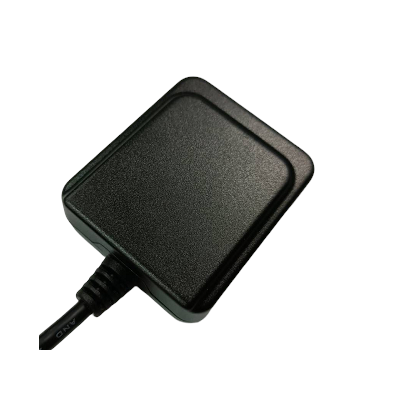


Navisys GR-M02 RS232 GNSS Receiver (Industrial Grade, L1 + L5 Dual-Band, 1.5m Accuracy, 10Hz Update Rate, IPX7 Waterproof, Fully EMI Shielded, Operating Temperatures from -40°C to +85°C)
Navisys GR-M02 RS232 GNSS Receiver (Industrial Grade, L1 + L5 Dual-Band, 1.5m Accuracy, 10Hz Update Rate, IPX7 Waterproof, Fully EMI Shielded, Operating Temperatures from -40°C to +85°C)
Country of Origin: Taiwan
Couldn't load pickup availability
Volume Discount Table
| Minimum Qty | Discount |
|---|---|
| 5 + | 3% off |
| 10 + | 4% off |
| 50 + | 5% off |
| 100 + | 7% off |

The NaviSys GR-M02 (RS232 version) is a high-quality GNSS receiver designed for industrial and commercial use. It is built on Airoha’s (a subsidiary of MediaTek) single-chip dual-band AG3335 engine, featuring 135 channels and supporting both L1 and L5 dual bands.
This dual-band capability allows the GR-M02 to receive signals from both L1 and L5 band satellites, effectively canceling out errors introduced when signals pass through the ionosphere and troposphere. This results in higher accuracy compared to single-band GNSS, with the GR-M02 achieving precision within 1.5 meters.
The 135 channels enable the GR-M02 to utilize more channels for faster satellite acquisition. Smart jammer detection across GPS, GLONASS, Galileo, and BeiDou helps keep positioning reliable in challenging RF environments such as drone navigation, vehicle tracking, and security monitoring.
Despite its capability set, the GR-M02 stays compact at 40 × 45 × 18.5 mm with a slim smart antenna. It is an industrial and commercial grade receiver with IPX7 waterproofing, full EMI shielding, a wide operating range from −40°C to +85°C, ultra-low power consumption at 94 mA, and an update rate of up to 10 Hz.
RS232 interface · L1 + L5 dual-band · 135 channels · 1.5 m accuracy · Up to 10 Hz · 94 mA · IPX7 · 40 × 45 × 18.5 mm · 3.3–5 VDC
Key Features
RS232 Industrial Interface
- RS232 serial output for industrial hosts
- UART default baud rate: 115200 bps (N-8-1)
- Supply: 3.3–5 VDC (RS232)
- Typical current: 94 mA average tracking
→ Direct RS232 connection for PCs, PLCs, and industrial controllers
L1 + L5 Dual-Band Accuracy
- Airoha AG3335 dual-band engine
- Horizontal: 1.5 m (L1+L5)
- Vertical: 2.25 m (L1+L5)
- CEP, 50%, 24 hr static, −130 dBm
→ Dual-band ranging helps reduce ionospheric error vs single-band GNSS
135 Channels · Faster Acquisition
- 135-channel AG3335 engine
- More channels for faster satellite acquisition
- Concurrent multi-constellation L1 / L5 tracking
→ Quicker fixes when you power on in the field
Smart Jammer Detection
- Smart jammer detection across GPS, GLONASS, Galileo, and BeiDou
- Real-time monitoring of interference signals
- Helps maintain reliable positioning under RF stress
→ Extra resilience for drones, vehicles, and security deployments
Up to 10 Hz Update Rate
- Max. update rate: 10 Hz (default 1 Hz)
- NMEA Ver. 3.01 and 4.10
- Default sentences: GGA, GSA, GSV, RMC, VTG
→ Higher refresh when you need denser track points
Industrial Form Factor
- 40 (W) × 45 (L) × 18.5 (H) mm
- IPX7 waterproof
- Fully EMI shielded
- Operating temperature: −40°C to +85°C
→ Built for outdoor and industrial deployment, not just lab benches
Navisys NaviViewerAh Tool
The manufacturer Navisys offers NaviViewerAh for easy configuration and diagnostics of the GR-M02 GNSS receiver. The screenshots below show satellite signal bars for L1 and L5, respectively.


Receiver Specifications
GNSS Receiver Type
- 135-channel Airoha AG3335 engine
L1
- 1602 MHz: GLONASS L1OF
- 1575.42 MHz: GPS & QZSS L1 C/A · SBAS L1 · QZSS L1 SAIF · Galileo E1 (E1B+E1C)
- 1561.098 MHz: BeiDou B1I
L5
- 1176.45 MHz: GPS & QZSS L5 · Galileo E5a · BeiDou B2a
Accuracy
| Horizontal position | Autonomous: 1.5 m (L1+L5 dual-band) CEP, 50%, 24 hr static, −130 dBm |
| Vertical position | Autonomous: 2.25 m (L1+L5 dual-band) CEP, 50%, 24 hr static, −130 dBm |
| Velocity | <0.05 m/s (speed) · 50% @ 30 m/s |
| PPS time pulse | ±10 ns clear sky, 1-sigma |
TTFF (Time to First Fix)
| Condition | Autonomous (50%, −130 dBm) |
| Hot start | 1 s |
| Warm start | 24 s |
| Cold start | 24 s |
Sensitivity
| Acquisition | −148 dBm |
| Tracking | −165 dBm |
Measurement Data Output
- Max. update rate: 10 Hz (default 1 Hz)
- NMEA output protocol: Ver. 3.01 and 4.10
- UART default baud rate: 115200 bps (N-8-1)
- Datum: WGS-84
- Default sentences: GGA, GSA, GSV, RMC, VTG
Dynamics & Limits
| Max. altitude | < 50,000 m |
| Max. velocity | < 500 m/s or 1,852 km/hr |
| Dynamics | < 4 g |
| SBAS | WAAS, EGNOS, MSAS, GAGAN |
| QZSS | SLAS (Sub-meter Level Augmentation) support in Japan only |
Power
| Power consumption | 94 mA / average tracking (RS232, 77 SVs used in fix) |
| Power supply | 3.3 ~ 5 VDC (RS232) |
Mechanical & Environment
| Dimension | 40 (W) × 45 (L) × 18.5 (H) mm |
| Operating temperature | −40°C to +85°C |
| Storage temperature | −40°C to +85°C |
What's in the Box
- Navisys GR-M02 GNSS Receiver × 1
Product Resources
Official Documents
Downloads
This GR-M02 TTL / RS232 variant uses a serial (UART) interface rather than USB. No USB driver install is required for the receiver itself. Connect via a compatible RS-232 port or TTL/UART host, then use the tool below for configuration and diagnostics.
Tools

How-to Articles and Blogs

Tech Support Topics and Forums